
Estmated Read: 4 minutes
A Sign of Things to Come
Apple recently announced it would begin releasing certain security updates earlier than usual, breaking from its practice of bundling fixes with major iOS releases. The reason: AI is helping attackers find and exploit flaws faster than ever, and waiting for the next scheduled window was no longer feasible.
Apple’s decision isn’t just about Apple. It reflects a broader shift across the cybersecurity landscape. As AI accelerates both cyberattacks and cyber defense, organizations can no longer rely on strategies designed for a slower-moving threat environment.
The old rhythm which was, a flaw is found, a patch is built, a fix rolls out on schedule, has been thrown off balance. The real story isn’t about one company’s launch schedule, it’s about that bigger shift.
AI Has Changed the Speed of Cyberattacks
For most of the past decade, launching a sophisticated cyberattack took real skill, time, and resources. This is what separated amateurs from serious, well-funded operations.
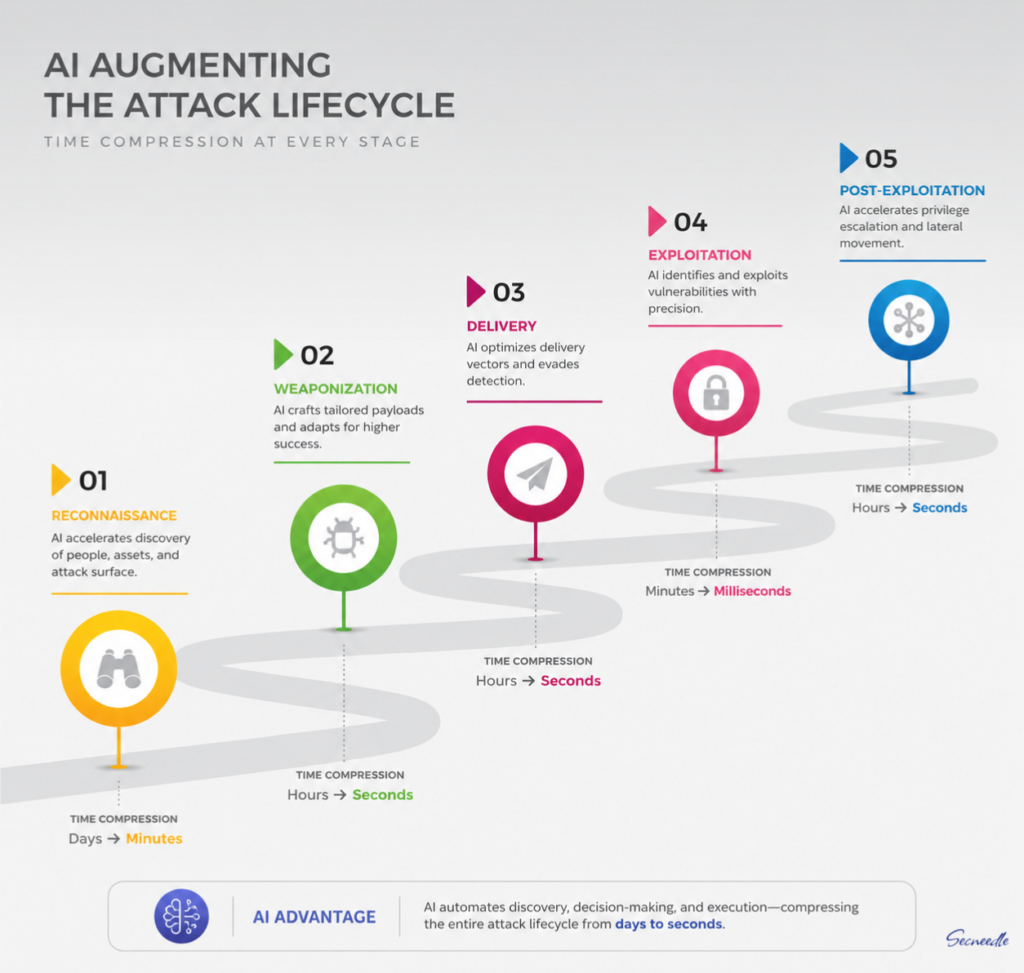
AI has erased much of that distinction. Generative tools can write convincing phishing emails in seconds, scan huge codebases for unknown vulnerabilities, and generate working exploit code with minimal human input. Recent research found 74% of IT security professionals have reported critical impacts from AI-fueled cyberattacks on their organizations.
Attackers no longer need months to weaponize a newly disclosed flaw, it now often takes hours or days. Phishing that once relied on generic messages is now built on scraped behavioral data, mimics a specific person’s writing style, and is increasingly paired with deepfake voice or video. This is the pressure Apple’s early-release decision responded to, the same pressure every organization is now under.
Why Traditional Cybersecurity Is No Longer Enough
Traditional cybersecurity rests on assumptions AI has quietly dismantled. Signature-based detection matches known threats against a database but AI-generated malware alters its own code on the fly, often matching nothing the database has seen. Scheduled patch cycles worked when the gap between discovery and exploitation was weeks or months; that gap has collapsed. Perimeter defenses assumed keeping attackers outside the network was the core job but AI-powered social engineering can now convincingly impersonate a trusted employee.
Even human security teams are outpaced: legacy tools already cause alert fatigue, and AI-driven attacks multiply that volume beyond what manual review can handle. Many organizations are still defending 2026’s threats with a 2015 playbook and that gap is exactly what attackers are counting on.
How Organizations Must Adapt
Meeting this moment takes more than a new tool. It requires a genuine shift in how organizations think about security.
° Move from periodic to continuous security, backed by real-time threat intelligence rather than annual audits.
° Adopt a resilience mindset; minimizing damage and recovering fast, not just keeping attackers out.
° Consolidate fragmented tools that create blind spots AI-driven attackers are built to find.
° Extend zero trust: since AI can impersonate trusted users, verify continuously, not just at login.
° Build faster patch deployment to close vulnerability windows in days, not months.
None of this is optional anymore, it’s the baseline cost of operating where the attacker’s toolkit updates faster than most security roadmaps.
AI Is Helping Defenders Too
It’s worth pausing here: AI isn’t purely a threat. It’s also becoming one of the most powerful tools defenders have.
AI-powered threat detection can analyze behavior across networks and endpoints to spot anomalies invisible to rule-based tools, flagging unusual behavior and catching novel attacks before they’ve ever been catalogued.
Some teams now operate on a “1-10-60” standard — detect in one minute, investigate in ten, act within sixty — achievable only with AI handling initial triage. Smaller organizations that could never staff a round-the-clock security team can now access AI platforms that extend a lean team’s reach. The analyst’s role hasn’t disappeared; it just moved up, from reacting to alerts to shaping the systems that respond automatically.
Challenges Organizations Still Face
Despite the promise of AI-powered defense, most organizations aren’t there yet, awareness is outrunning readiness. Skilled talent remains scarce, budgets are stretched thin, and integrating AI tools into aging infrastructure is rarely as simple as flipping a switch.
There are new risks bundled with AI adoption too: data provenance concerns, algorithmic bias, and over-relying on automation to the point human judgment gets sidelined right when it matters most. Closing the gap between knowing what to do and having the capacity to do it is, at this point, the central challenge.
Apple’s Decision as a Case Study
Returning to where this started: Apple’s choice to accelerate its update schedule is a useful, concrete example of the shift already underway. Notably, Apple wasn’t responding to an active attack, its patches addressed flaws with no evidence of exploitation before the fix shipped. This was a proactive recalibration, made because the old timeline no longer matched the new threat reality.
A company with Apple’s resources and one of the industry’s most disciplined release processes concluding that bundled updates weren’t fast enough alone is a fair signal that most other organizations, with far fewer resources, are even further behind the curve. It’s not a template to copy exactly, but it is a clear, public data point confirming what this article has argued: AI-driven threats are forcing a rethink of assumptions once considered solid.
Conclusion: Key Takeaways
AI has changed cybersecurity on both sides of the fight, making attacks faster and more convincing, while giving defenders tools that respond at a speed no human team could match alone. Organizations that treat this as a minor update rather than a fundamental shift are the ones most likely to be caught off guard.
- AI has compressed attacker timelines from months to hours, eliminating the margin traditional security processes relied on.
- Signature-based detection, periodic patching, and perimeter-only defenses are no longer sufficient alone.
- Adapting requires continuous security, a resilience-first mindset, consolidated tools, and faster patch deployment.
- AI is also one of the most effective tools defenders have, enabling detection and response at machine speed.
- The biggest ongoing challenge is building the talent, budget, and infrastructure to actually respond, not just awareness.
- Apple’s early updates are one visible example of a shift already happening industry-wide, not an isolated policy.
The organizations that come out ahead won’t necessarily have the biggest budgets. They’ll be the ones that recognized early that the old rules no longer apply and built something better before they were forced to.
References
- Satter, R. (Reuters) (2026, June 29). Apple says it is releasing updates early in response to AI cybersecurity concerns. U.S. News & World Report. https://www.usnews.com/news/top-news/articles/2026-06-29/apple-says-it-is-releasing-updates-early-in-response-to-ai-cybersecurity-concerns
- SC Media (2026, July 1). Apple releases early security updates, citing AI-driven exploit acceleration. SC World. https://www.scworld.com/brief/apple-releases-early-security-updates-citing-ai-driven-exploit-acceleration
- PYMNTS (2026, June 29). Apple Accelerates Security Updates to Preempt AI-Powered Exploits. PYMNTS.com. https://www.pymnts.com/cybersecurity/2026/apple-accelerates-security-updates-preempt-ai-powered-exploits/
- SentinelOne (2026). 9 AI Cybersecurity Trends to Watch in 2026. SentinelOne Cybersecurity 101. https://www.sentinelone.com/cybersecurity-101/data-and-ai/ai-cybersecurity-trends/
- SentinelOne (2026). 8 AI Cybersecurity Companies For 2026. SentinelOne Cybersecurity 101. https://www.sentinelone.com/cybersecurity-101/data-and-ai/ai-cybersecurity-companies/
- Fortinet (2026). Artificial Intelligence (AI) in Cybersecurity: The Future of Threat Defense. Fortinet Cyber Glossary. https://www.fortinet.com/resources/cyberglossary/artificial-intelligence-in-cybersecurity
- Cynet (2026, May 6). AI Cyberattacks 2026: New Artificial Intelligence Threats & Defense Strategies. Cynet Security Foundations. https://www.cynet.com/security-foundations/ai-machine-learning/ai-cyberattacks/
- Ridge IT Cyber (2025, December 12). AI Threat Detection 2026: Defense vs. AI-Powered Attacks. Ridge IT Cyber. https://www.ridgeit.com/ai-cybersecurity-defense-2026/
- Analytics Insight (2026). How AI-Powered Threat Detection is Transforming Cybersecurity in 2026. Analytics Insight. https://www.analyticsinsight.net/cybersecurity/how-ai-powered-threat-detection-is-transforming-cybersecurity
- Cycode (2026, March 30). The 10 Best AI Cybersecurity Tools in 2026. Cycode Blog. https://cycode.com/blog/ai-cybersecurity-tools/
- The Hacker News (2026, July 1). 2026 Cybersecurity Assessment: The Gap Between Awareness and Resilience. The Hacker News. https://thehackernews.com/2026/07/2026-cybersecurity-assessment-gap.html
- CIO.com (2026, April 11). The state of AI security in 2026. CIO. https://www.cio.com/article/4157398/the-state-of-ai-security-in-2026.html