
Estimated Read: 9 minutes
“What used to take thousands of personnel on a nation-state team can now be accomplished with just two individuals.” – Rob T. Lee, Chief AI Officer & Chief of Research, SANS Institute
The Rules of the Game Just Changed
For most of the past decade, when a critical software vulnerability was discovered, organizations had weeks, sometimes months, to respond. Security teams could deliberate, test patches, schedule maintenance windows, and apply fixes at a measured pace. That era is over.
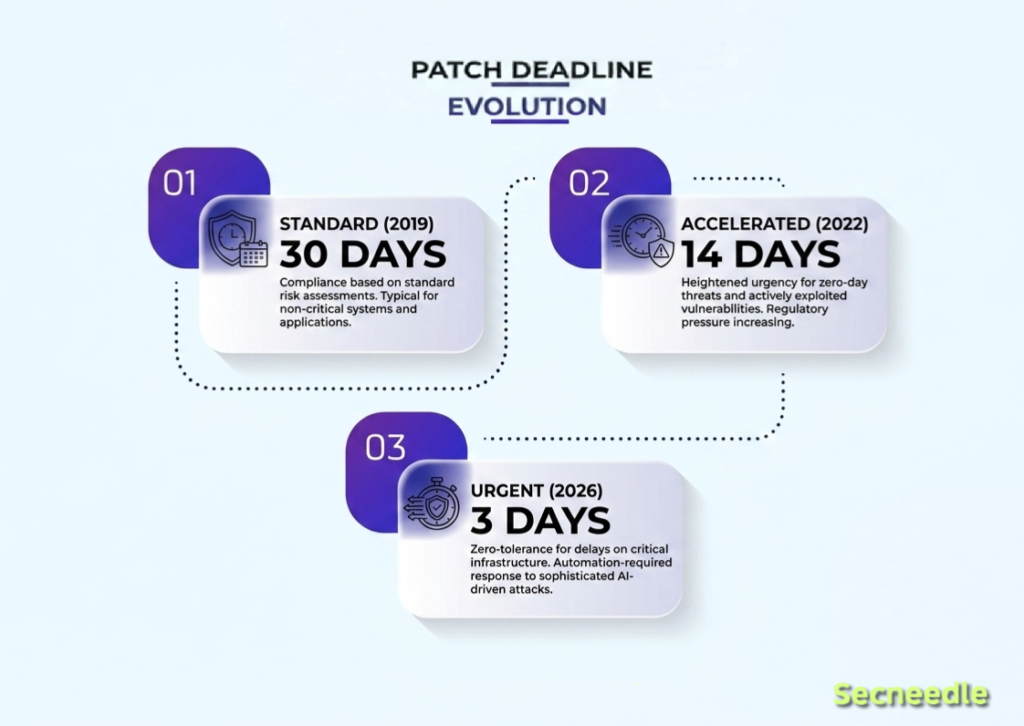
On June 10, 2026, the U.S. Cybersecurity and Infrastructure Security Agency (CISA) issued Binding Operational Directive (BOD) 26-04: Prioritizing Security Updates Based on Risk, a landmark directive that now requires federal civilian agencies to patch the most critical vulnerabilities within 72 hours. Three days. Not three weeks. Not 30 days. Three days!!!
The driving force behind this seismic shift? Artificial intelligence. AI-powered tools are enabling attackers to discover and exploit software flaws faster than any human team could previously imagine, compressing what once took months of skilled hacking into automated campaigns that launch in hours.
The question this directive raises for every organization, not just government agencies, is uncomfortable and urgent: Can we actually patch fast enough to survive in the age of AI-driven cyberattacks?
The New Rule: What BOD 26-04 Actually Requires
Before we examine whether 72-hour patching is realistic, we need to understand what CISA has actually mandated, and why.
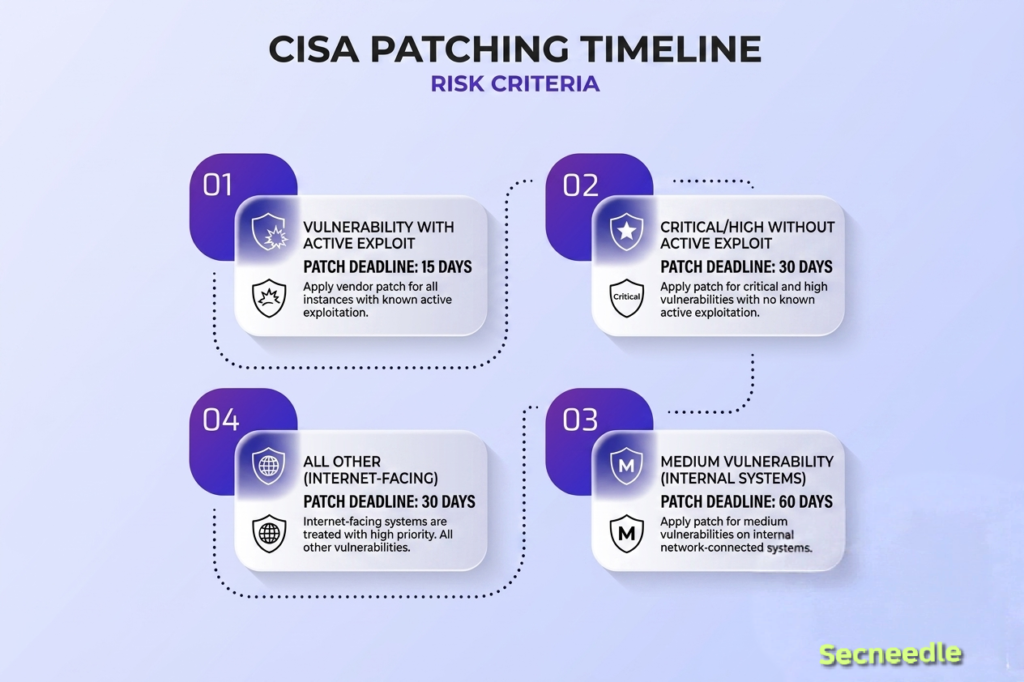
BOD 26-04 replaces two earlier directives, BOD 19-02 and BOD 22-01, and introduces a risk-based prioritization framework that evaluates every vulnerability against four key criteria:
° Asset Exposure – Is the vulnerable asset publicly accessible on the internet?
° KEV Status – Is the vulnerability listed in CISA’s Known Exploited Vulnerabilities (KEV) catalog, confirming active exploitation in the wild?
° Exploit Automation – Can attackers automate exploitation of the flaw?
° Post-Exploitation Technical Impact – Does successful exploitation grant an attacker “partial” or “total” control of the compromised system?
The strictest 72-hour deadline applies only when a vulnerability scores high on all four criteria: publicly exposed, actively exploited, automatable, and grants total system control. Vulnerabilities meeting three out of four criteria face 14-day timelines, while lower-risk flaws may have windows of up to 60 days.
There is a further requirement that makes this directive particularly demanding: forensic triage. When a vulnerability meets the highest-risk threshold, agencies cannot simply install a patch and move on. CISA now mandates that organizations investigate whether a compromise has already occurred before applying remediation, because installing a patch does not evict an attacker who may already be living inside your network.
Why Now? The AI Acceleration Problem
To understand the urgency, consider the baseline that existed before AI entered the picture. The median time for an organization to remediate half of its open, internet-facing vulnerabilities was 361 days. Meanwhile, exploitation of newly disclosed flaws happened in hours, not days or weeks. Research published in 2026 reveals that one-third of exploited Common Vulnerabilities and Exposure CVEs in the first half of 2025 showed attacker activity on or before the day of public disclosure, meaning defenders were already behind before they even knew a patch existed.
AI has made this asymmetry dramatically worse. Here is what the data reveals:
° 48,244 new CVEs were published in 2025 alone, a 20% year-over-year increase, with high-severity findings climbing 10% compared to 2024
° CrowdStrike’s 2026 Global Threat Report documented a 42% year-over-year increase in zero-day vulnerabilities exploited before public disclosure.
° Threat intelligence firm VulnCheck reported that 29% of KEV-level vulnerabilities in 2025 showed evidence of exploitation on or before the CVE’s publication date.
° Cisco announced it would begin issuing vulnerability disclosures twice a month, citing the growing role of AI tools in uncovering security flaws faster than traditional security teams can triage and patch them.
° Adversaries have demonstrated they can operationalize publicly disclosed exploits within two days of release.
Advanced AI models are now capable of scanning enormous codebases to identify previously unknown vulnerabilities, generate working exploits, and launch attacks, all with minimal human supervision. As Rob T. Lee of the SANS Institute observed, AI has transformed the economics of cyberattacks: operations that once required nation-state teams of thousands can now be executed by just two individuals with the right AI tooling.
The asymmetry is real, and it is growing.
What “Patch in 72 Hours” Actually Demands From an Organization
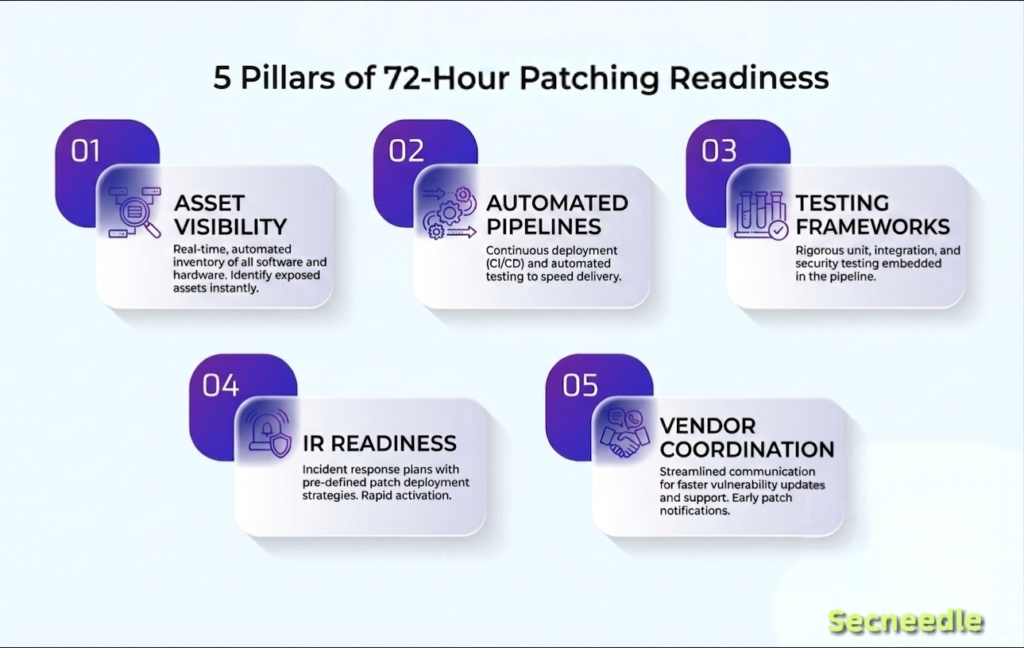
Whether or not an organization is bound by BOD 26-04, the directive signals where the entire industry is heading. CISA has explicitly encouraged private-sector organizations to adopt similar risk-based vulnerability management practices. Here is what achieving 72-hour patching capability actually requires:
1. Complete Asset Visibility
You cannot patch what you do not know exists. The CISA directive begins its clock the moment a vulnerability is added to the KEV catalog or the moment an agency identifies it on an asset, whichever comes first. Organizations with incomplete or outdated asset inventories will fail before they start. Continuous, automated asset discovery is not optional; it is a prerequisite.
2. Automated Patching Pipelines
Manual patching processes cannot meet 72-hour deadlines at scale. Organizations need automated vulnerability detection, prioritization, and patch deployment pipelines, ideally connected to threat intelligence feeds that flag KEV additions in real time.
3. Pre-Built Testing Frameworks
The reason organizations take weeks to patch is largely due to the time required to test that a patch does not break existing functionality. Organizations that maintain robust, automated regression testing environments can compress this step from days to hours.
4. Incident Response Readiness
BOD 26-04’s forensic triage requirement reflects a profound truth: a patch is not a recovery. If an attacker exploited a vulnerability before the patch was applied, remediating the flaw without investigating the intrusion leaves the attacker inside. Organizations need practiced incident response capabilities, not theoretical ones.
5. Vendor and Supply Chain Coordination
Many vulnerabilities involve third-party software embedded in organizational systems. CISA’s guidance acknowledges this complexity and directs agencies to contact vendors directly for patches or workarounds. Supply chain relationships need to be pre-established, not scrambled for under a 72-hour deadline.
Looking Ahead: The Road to Machine-Speed Defense
The 72-hour patching mandate is not an endpoint. It is a waypoint on a trajectory that leads toward automated, machine-speed cyber defense.
The underlying logic is straightforward: if attackers are deploying AI to identify and exploit vulnerabilities in hours, defenders cannot rely on human-paced response cycles. The future of vulnerability management is one where AI-assisted defenders, scanning for threats, triaging risks, and deploying patches, operate in near real-time, matching attacker speed with defensive speed.
CISA’s BOD 26-04 is a forcing function for that transformation. By mandating outcomes that are difficult to achieve manually, the directive pushes organizations toward the automation and continuous monitoring capabilities that next-generation cybersecurity demands. The directive explicitly supports objectives outlined in the Executive Order on Promoting Advanced Artificial Intelligence Innovation and Security, a recognition at the highest levels of the U.S. government that AI is not merely a productivity tool but a national security variable.
For security leaders, the message is clear: the old playbook of scheduled patch cycles and monthly vulnerability reviews is obsolete. The new standard is continuous, risk-based, intelligence-driven vulnerability management, with the most dangerous flaws addressed before the weekend is over.
Conclusion: The Clock Is Already Running
The 72-hour window for patching critical vulnerabilities is simultaneously ambitious and necessary. It is ambitious because most organizations, public and private, are not built for it today. It is necessary because the threat environment AI has created does not wait for organizational convenience.
CISA’s BOD 26-04 is a wake-up call delivered in the form of a directive. For federal agencies, compliance is mandatory. For everyone else, the question is not whether to adopt this standard of urgency, it is how quickly you can build the capability to meet it.
In cybersecurity at machine speed, even a three-day deadline can be a generous window for an AI-powered adversary.
Key Takeaways
° CISA BOD 26-04 (June 10, 2026): Federal civilian agencies must patch the most critical vulnerabilities within 72 hours.
° Four-factor risk framework: Asset exposure, active exploitation status (KEV), exploit automation potential, and technical impact severity.
° AI is the primary driver: AI has compressed vulnerability exploitation timelines from weeks to hours.
° Scale of the problem: 48,244 CVEs published in 2025, with 29% of high-severity KEV vulnerabilities exploited on or before their CVE publication date.
° 72-hour patching demands: Complete asset visibility, automated pipelines, pre-built testing frameworks, incident response readiness, and vendor coordination.
° Industry benchmark: The directive is expected to set a de facto standard for private-sector organizations, particularly in regulated industries or federal contracting.
References
° CISA (2026, June 10). BOD 26-04: Prioritizing Security Updates Based on Risk. Cybersecurity and Infrastructure Security Agency. https://www.cisa.gov/news-events/directives/bod-26-04-prioritizing-security-updates-based-risk
° CISA (2026, June 10). BOD 26-04 Implementation Guidance. Cybersecurity and Infrastructure Security Agency. https://www.cisa.gov/news-events/directives/bod-26-04-implementation-guidance-prioritizing-security-updates-based-risk
° CISA (2026, June 10). CISA Issues New Directive Improving How Federal Agencies Prioritize the Mitigation of Cyber Vulnerabilities. CISA Press Release. https://www.cisa.gov/news-events/news/cisa-issues-new-directive-improving-how-federal-agencies-prioritize-mitigation-cyber-vulnerabilities
° Cybernews (2026, June). US federal agencies face new 3-day patching deadline amid AI-driven cyber threats. Cybernews. https://cybernews.com/security/cisa-3-day-deadline-critical-vulnerabilities-ai-cyberattacks/
° Cybernews (2026, May 13). US officials consider slashing vulnerability patch deadlines to 3 days over AI threats. Cybernews. https://cybernews.com/security/us-cybersecurity-3-day-patch-deadline-ai-threats/
° Federal News Network (2026, May 19). AI drives new debate around CISA software patching deadlines. Federal News Network. https://federalnewsnetwork.com/cybersecurity/2026/05/ai-drives-new-debate-around-cisa-software-patching-deadlines/
° Nextgov/FCW (2026, May). AI is compressing attack timelines. Here’s how agencies can respond. Nextgov. https://www.nextgov.com/ideas/2026/05/ai-compressing-attack-timelines-heres-how-agencies-can-respond/413796/
° GovInfoSecurity (2026, March 29). AI Shrinks Cyberattack Exploit Time From Years to Days. GovInfoSecurity. https://www.govinfosecurity.com/ai-shrinks-cyberattack-exploit-time-from-years-to-days-a-31219
° Help Net Security (2026, May 18). AI shrinks vulnerability exploitation window to hours — Synack 2025 Report. Help Net Security. https://www.helpnetsecurity.com/2026/05/18/synack-2025-ai-driven-vulnerability-trends-report/
° Cloud Latitude (2026, June). From weeks to 3 days to patch: AI-driven vulnerability discovery. Cloud Latitude. https://cloudlatitude.com/insights/security/ai-driven-vulnerability-discovery-just-shrank-your-patching-window-to-3-days/
° CSO Online (2026, May 5). CISA mulls new three-day remediation deadline for critical flaws. CSO Online. https://www.csoonline.com/article/4167422/cisa-mulls-new-three-day-remediation-deadline-for-critical-flaws.html
° The Cyber Express (2026, June). CISA Vulnerability Management Directive Tightens Timelines. The Cyber Express. https://thecyberexpress.com/cisa-vulnerability-management-directive/
° Wiley Law (2026, June). CISA Directive Highlights Risk-Based Vulnerability Management. Wiley Law. https://www.wiley.law/alert-CISA-Directive-Highlights-Risk-Based-Vulnerability-Management
° The Hack Academy (2026, June). US Government Shortens Cyber Fix Window To Three Days As AI Threats Rise. The Hack Academy. https://www.thehackacademy.com/news/us-government-shortens-cyber-fix-window-to-three-days-as-ai-threats-rise/